Wednesday, 16 June 2010

Once in a lifetime

There are still a few minutes to go before sunset and the summit tourists are preparing for a treat. Most payed something like $200 to be taken to the summit with a tour company and although that's an awful lot of money they are treated very well from what I've heard. On the way down they get to see the amazing night sky from either the Visitor Center at the 9,000 foot level or the tour company will provide telescopes for viewing from some of the other dark viewing spots on the mountain.

Unless you're an utter astronomy freak though, sunset is the highlight of the trip. You can watch beautiful sunsets from anywhere on the planet, but watching the sun sink below the clouds from the highest point in the Pacific Ocean is very special. I've lived and worked here nearly 14 years and I don't get bored of the view. It's very nearly 20 years since I watched my first sunset from the summit of Mauna Kea as a visiting astronomer-in-training.

I plan to mark the 20-year anniversary by watching another Mauna Kea sunset and will post the photos here, but it's not for a few months yet!

Even the astronomers and those that work at the observatories want to watch the sunset. In the top photo you can just make out the staff standing by the Gemini mirror inside the dome watching the magical view, and in the one above, the observing team for the night are outside taking in another amazing evening view from the CFHT.

Some of this might also be due to many of the observatories planning to switch to remote operations. It's very hard to imagine that I won't be up on the summit after this year, especially after such a long career spent on the summit. The CFHT are planning remote operations as well and the rumour is Gemini are also looking at the possibility.

It feels very much like the end of an era.

PS. Those shadows below the CFHT are from the Keck telescopes and Subaru.

Tuesday, 15 June 2010

Dirty picture

Anyone know a window cleaner who's willing to work at 14,000 feet?

Monday, 14 June 2010

All cloudy on the western front

Not my best panorama, but the sunset clouds were stunning.

Sunday, 13 June 2010

Economy woes

More from a couple of my favourite comedians:


Clarke and Dawe made a previous appearance on this blog when they discussed oil spills. It seems things never change

Changing conditions

The last few nights have seen some bizarre changes in observing conditions. We've gone from some relatively average conditions (seeing around 0.6" for those who know what I mean) to absolutely stunning seeing (~0.3", natural) and within half an hour to a terrible upper atmosphere that our guider couldn't cope with followed almost immediately by a mini ice storm and freezing fog. Tonight the seeing remains awful and highly variable but I'm sure the atmosphere will sort itself out soon.

Down below, the conditions have been changing daily, but they did allow a quick view of the Hualalai volcano with little cloud between it and us at Mauna Kea's summit. Unfortunately, the unusual evening view was spoiled by vog which you can see floating around below Haulalai's summit. Still, the vog does make for an unusual looking picture.

Saturday, 12 June 2010

No ocean view today

With a weather system moving in the inversion layer is much higher this evening and there's a lot more low level cloud. This means, unlike yesterday's amazing view, there's no ocean visible from the top of Mauna Kea. Instead, we have to make do with some of the other sights we get to see at sunset, such as the shadow of the mountain and anticrepuscular rays above, and below, colourful cirrus clouds to the west.

Friday, 11 June 2010

A Pacific view

Light from the setting sun reflects off the Pacific ocean thousands of feet below while crepuscular rays bathe the distant Kohala coastline. The silhouette of the Subaru Observatory sits in the foreground.

Where did this piece go?

Fortunately I'm not holding a large bolt in my hand and asking the engineers if they know which bit of the telescope it came from. Our engineering team put everything back together so precisely after our recent realumunisition work (see here and here) that tonight it was hardly necessary to make any adjustments at all in order for us to take science data again. We were doing science observations just an hour after sunset on our first night back when in fact we had scheduled two and a half nights of engineering to get us up to speed again!

We still have to do some very careful realignment which we're doing now as the telescope structure has cooled off sufficiently to give us stable conditions. In another hour I'll start doing the sums to make sure both the primary and secondary mirrors are aligned correctly and that they also make the proper corrections depending where on the sky we are pointing. Just the sort of thing you want to do be doing at two o'clock in the morning at 14,000 feet...

We should be fully back in business at the start of tomorrow night I'm pleased to say.

Sunday, 6 June 2010

Minimalist mode at UKIRT

"Minimalist mode" almost sounds like some sort of new art fad or perhaps a new way of cooking nouvelle cuisine, but it's the term that's being used to describe the new operating mode that UKIRT will switch to at the end of the year.

A few weeks ago I hinted that UKIRT would be undergoing the most significant operational change in its history and it's now official. The announcement is available under the "Latest News" section on the the UKIRT home page and you can read it here - "A Minimalist Operating Mode for UKIRT".

The argument for switching to this new mode is actually quite simple. The Joint Astronomy Centre (JAC) runs both the JCMT and UKIRT and many resources are shared. The JCMT is currently commissioning SCUBA-2 which is a high priority project. If UKIRT were to close to save costs, then those resources are no longer shared and the costs for running the JCMT increase. The trick is to find a way to reduce the costs of UKIRT so that the savings equal the increase in costs of running the JCMT on its own. This is what minimalist mode achieves and in effect means the UKIRT delivers its excellent science for free. Well - perhaps a little simplistic but that's essentially the reason UKIRT survives for now and it also allows us some more time to explore future funding possibilities.

Still, it's going to be a painful process for many because as the announcement says, staffing numbers will be reduced. The next few months are going to be quite challenging.

Saturday, 5 June 2010

The primary returns

No, nothing to do with politics or voting, but our primary mirror is back at UKIRT with a beautiful new coating. Some of you may have read my post about our primary mirror being removed and taken to the CFHT for realuminising. Well, it was returned on Thursday after going through the process and I can't say how happy we are with the job the CFHT did. The coating is wonderful and our measurements showed that the quality is literally as good as gold at 3.3 microns, which is about the best you could get.

No pretty pictures I'm afraid, just some snapshots of the day we got our mirror back, and I apologise for the odd colours from the CFHT clean room.

UKIRT's primary mirror emerges from the vacuum chamber where it had been coated with a few hunderd Angstroms of aluminium (and I'm going to use the American word aluminum from now on!).

This infrared scatterometer is what we used to confirm the quality of the new coating. Unfortunately it's rather unstable and as usual when scientists and engineers get together all sorts of theories, solutions and experiments were discussed, but finally we agreed that the mirror surface was giving us the same result as if it had been coated in gold.

Erik, one of our engineers, is pretty proud of the result. He's been working here almost as long as I have by the way! The odd looking striations on the mirror had me panicing at first when I saw this picture, but they're simply reflections from the lab's wall. At least we know the mirror is reflecting stuff, which, after all, is what it's supposed to do!

The mirror is very gently lifted from its support in preparation for its transport to UKIRT. I had asked our chief engineer beforehand if I needed to wear a hard hat while I visited the CFHT and he said that for this part of the work I should wear one. He then pointed out it'd probably be no use other than to help identify me after an accident. Now I know what he meant! This is several tons of glass being lifted.

Finally, after a few hours, the primary is slowly lowered onto the truck. Everyone here is being extraordinarily careful because we can't risk any damage. We don't have a spare primary.

Off it goes back to its home at UKIRT accompanied by our own security detail!

Convoy!

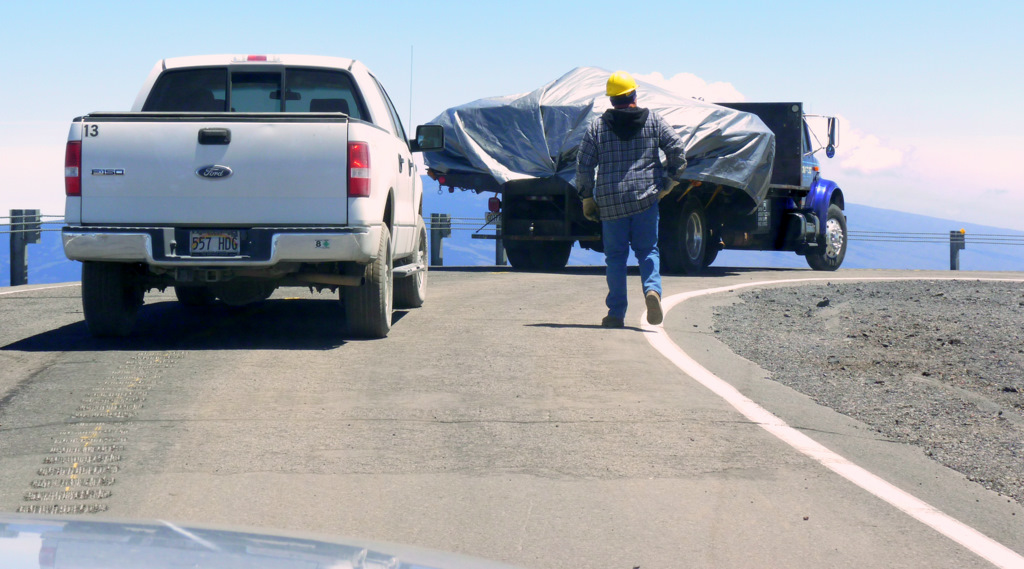
It's only a few hundred yards between the CFHT and UKIRT but you have to remember it's a massive piece of delicate glass being transported on a large truck - you can't do this quickly. We also had to block the road for a short time to make sure some of the more enthusiastic tourists on the summit didn't hinder the operation and for the most part they didn't!

The primary is now back in UKIRT's dome and we're planning a quick check of everything on Wednesday night which I'll be doing - we have to find those bits and pieces that everyone finds after putting something back together and wonders where this bit went.

After that it's back on sky Thursday night and I have the privilege of getting everything working again. I'm looking forward to it because that's the one job I know I'm good at.