
No picture, no news about UKIRT. I just want to say how horrified I am by recent events in the US. Systematic racism has been here for centuries let alone decades, but we should be a more educated and caring society now. But we aren't. And nothing will change unless we have leadership.
The US once had leadership, it no longer does. We now have peaceful protesters being physically removed from a public area just so the president can have a photo op at St John's Chuch in D.C. The US now has a president who threatens to use the military against its own citizens. This is not America, it's more akin to a dictatorship in Africa or South America. I hope most citizens of the US can see this but I fear the loud, idiotic and, let's face it, racist minority, are winning with the support of the president.
This is no longer the country I love. Trump said it's the greatest country in the World. No, it isn't, not anymore.
Monday, 1 June 2020


Friday, 27 February 2015
Goodbye, JAC, long live the JAC.
A sad day today, the Joint Astronomy Centre (JAC) will close for business on Saturday 28th February. The JAC has been around for decades and supported both UKIRT and the JCMT. UKIRT left in November 2014 but still used JAC staff for support, but now JCMT will be moving to new ownership this weekend.
The building still exists and both JCMT and UKIRT staff are still there, but the whole organisation that glued us together will be gone. It's quite a sad time but also, a new beginning for both telescopes.
Will Montgomerie, a telescope system specialist at the JCMT, just published this wonderful video as a tribute to the JAC and JCMT, and hope you enjoy it. I'm continually amazed by some of the hidden talents JAC employees have. This video is particularly special:
Starlapse: The James Clerk Maxwell Telescope from William Montgomerie on Vimeo.
The building still exists and both JCMT and UKIRT staff are still there, but the whole organisation that glued us together will be gone. It's quite a sad time but also, a new beginning for both telescopes.
Will Montgomerie, a telescope system specialist at the JCMT, just published this wonderful video as a tribute to the JAC and JCMT, and hope you enjoy it. I'm continually amazed by some of the hidden talents JAC employees have. This video is particularly special:
Starlapse: The James Clerk Maxwell Telescope from William Montgomerie on Vimeo.
Thursday, 30 October 2014
End of an era

Tonight is the last night UKIRT operates as a UK telescope. We are closed Friday night during which the changeover to a new operator, the University of Arizona, takes place.
I have worked at UKIRT for 18 years and have observed there since 1991. My feelings are mixed. I am very excited about the future as UKIRT moves ahead and reinvents itself once again. We are moving into areas UKIRT was never designed for but we demonstrated this summer it was quite capable of carrying out its new science mission. I am also sad because I know so many people I have worked with in the past in the UK will likely never visit again. Fortunately, there is interest from the UK astronomical community in staying connected to the telescope. You never know, many old friends may well come out to visit us again, as they did this past week to celebrate UKIRT's achievements, history and its future.
Thank you to everyone who made UKIRT what it is today, and to those who made its future possible.
Monday, 11 August 2014
Hurricane Iselle's aftermath
Hawaii, especially the district of Puna on the Big Island, rarely makes the news, even on the local TV stations in the State. It's a neglected district with many quite poor people living here. Some areas are very beautiful and have many vacation rentals for visitors, some are ravaged by lava flows, but overall it is a large area (roughly the size of Oahu) with thousands of relatively poor families.
Hurricane Iselle devastated much of the district last Thursday night. Thousands of people are without power or running water, some are still trapped on their streets by downed trees. Houses have been damaged or even completely destroyed. Power for many residents won't be back for several weeks despite the heroic efforts of hundreds of local workers and residents, including the National Guard.
I was lucky, I only lost power and water for two days and have only had a relatively small amount of damage to deal with. The further south and east you go into Puna from my place though, the worse things get.
If you are able to donate a little money to help people and families suffering dreadfully after the storm, you can do so via this link:
http://www.hiunitedway.org/iselle/
And now a video posted by a good friend's nephew:
Hurricane Iselle devastated much of the district last Thursday night. Thousands of people are without power or running water, some are still trapped on their streets by downed trees. Houses have been damaged or even completely destroyed. Power for many residents won't be back for several weeks despite the heroic efforts of hundreds of local workers and residents, including the National Guard.
I was lucky, I only lost power and water for two days and have only had a relatively small amount of damage to deal with. The further south and east you go into Puna from my place though, the worse things get.
If you are able to donate a little money to help people and families suffering dreadfully after the storm, you can do so via this link:
http://www.hiunitedway.org/iselle/
And now a video posted by a good friend's nephew:
Wednesday, 23 April 2014
Well, it's in the public domain now - UKIRT's future

Latest news can be seen here -SFGate news about UKIRT. I'm sure other media sources will pick things up over the next day or so. Local rags picked it up quickly but aren't the places I want to direct people to. Don't know anything about SFGate, but haven't hit a paywall there yet.
Friday, 14 March 2014
The Long Goodbye

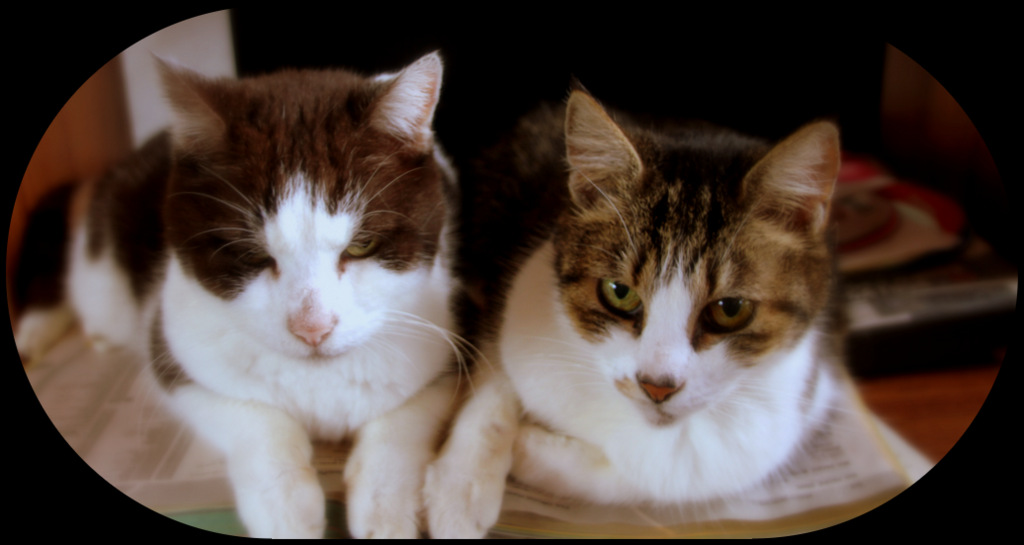
Eddie, the cat on the right, has been with me almost since the day I arrived in Hawaii. She's approaching 18 years old now and as a kitten wasn't expected to survive her first year. She was 10-weeks old and just skin and bones and clearly the runt of the litter when I adopted her. The person at the Humane Society told me she needed a lot of love and care to survive, and when her adopted sister, Patsy, died just a few weeks later from FIP, the vet said it was likely she had contracted the disease as well and would die young.
Well, over 17 years later she is still with me, nearly as energetic as she ever was, but the big C has been diagnosed and she has little time left. Because of her age there are no realistic treatment options other than to make sure what little time she has left is as comfortable as possible, and, of course, to feel loved.
It's amazing what an animal can do to you. Before I adopted Eddie I did not particularly like cats, I was always a dog lover, but she has been special. Right now, even though she isn't at her best, she's sitting by my feet watching me type these words although she's probably just watching to see if I have more food for her! There's almost been a human-dog-like companionship between us; she waits for me each evening at the front porch to come home from work and follows wherever I go. She'll even sit on command (sometimes). When she knows it's the right time, she comes to me for petting and a little affection, but also knows when I need time alone. But she's always there when that time ends, often with a little kiss on my nose.
In a couple of months this will come to an end. It will be hard but I know I've given her the best life possible and a much longer one than she would have had if we hadn't met.
Wednesday, 18 December 2013
A room with a view

I now have only a short trip in the future to achieve and complete a small ambition of mine, which is to have driven the entire coast of California and Oregon: Los Angeles to San Diego.
Saturday, 14 December 2013
California sunset

It's been almost a year since I last posted anything here. Sorry about that. The reasons are both personal and professional and I'm not up to updating anyone on either of those right now. But I did want to share an amazing sunset both Pam and I saw a week or so before Thanksgiving.


I felt very safe, especially as I wasn't in the water and I didn't see any muggers or assassins near me. Lots of people were there that evening because the sunset the previous evening was even more spectacular and everyone was on the beach wanting to see the same thing again. The sunset wasn't quite as good but it was still wonderful to watch. Unfortunately Pam and I were on the road the evening before, so didn't have the chance to capture what was a stunning sight (we saw the sunset from Hwy 101), but this wasn't too bad either.
I have a great picture from further up north I want to share, but won't for now. Pam gets it as her Christmas present which I hope will remind her of the wonderful places we visited on our recent 3000-mile road trip.
And, for those interested, once I can post something about UKIRT's future (and mine), I will!
Wednesday, 30 January 2013
So what?
We don't care about publication rates. We want our dinner. Now. Otherwise your phone book isn't going anywhere.
Tuesday, 29 January 2013
UKIRT sets yet another publication record

Subscribe to:
Posts (Atom)

